
McIntosh County Court Records After Arrest
McIntosh County criminal cases route through the Atlantic Judicial Circuit. The GSCCCA McIntosh County clerk page identifies Cheryl "Mandy" Harrison as Clerk of Superior Court and lists McIntosh County Court at 310 North Way, P.O. Box 1661, Darien, GA 31305. The clerk manages Superior, State, and Juvenile court records. The same source lists office hours as 8:00am to 5:00pm Monday through Friday, phone 912-437-6641, and view screens available for courthouse access.
The arrest-to-court path has several stages. A person is first booked into the jail or held on a warrant. Jail staff record the booking charge, bond, arresting agency, booking date, and other custody fields. The first appearance or commitment process follows. Then prosecutors review the law-enforcement file and decide what charge should be filed in court. That filed charge may match the booking charge, but it can also be amended, reduced, dismissed, or presented to a grand jury for indictment.
For custody and booking details, use McIntosh County jail inmate records. For booking photos and Georgia booking-photo restrictions, use McIntosh County jail mugshots. Court records after a jail arrest are a different record set because they show the case opened and maintained by the clerk and court after filing.
Find Court Records After Arrest
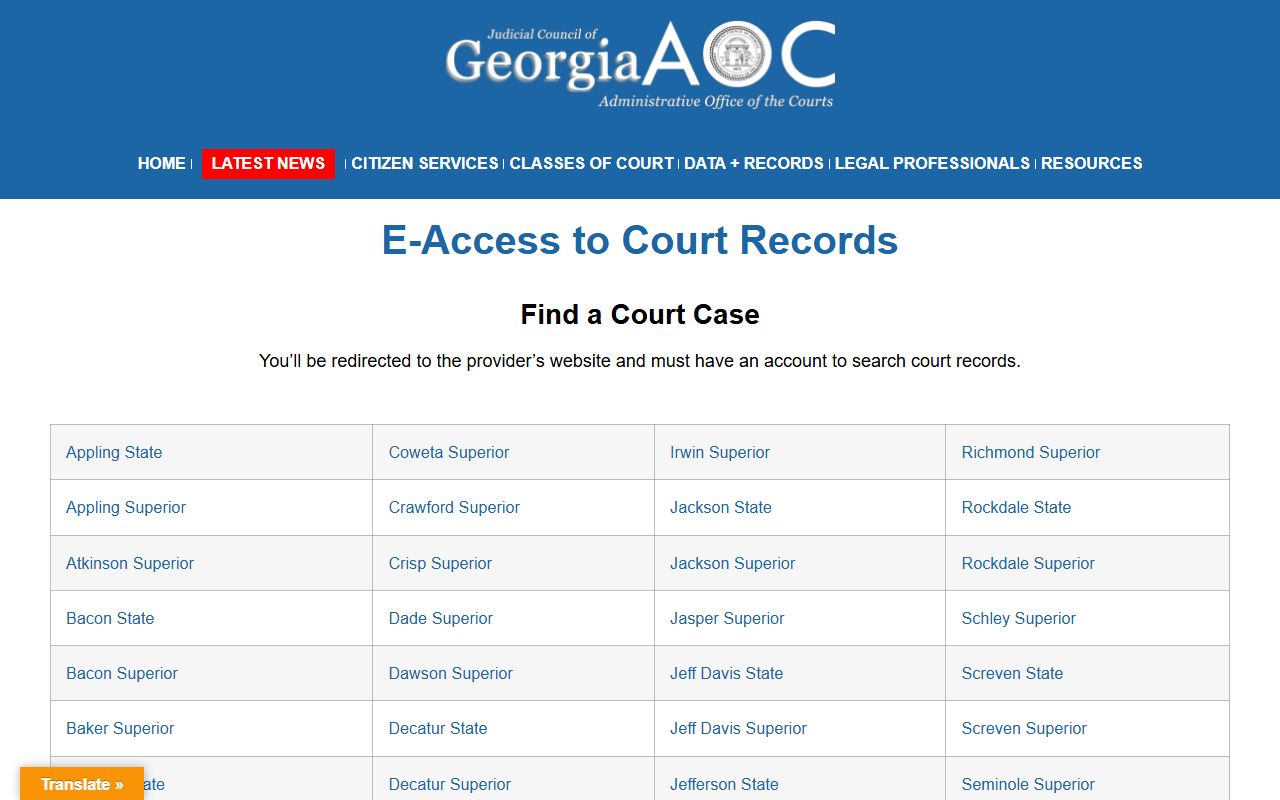
Online case lookup for McIntosh County court records after arrest runs through Georgia's e-access structure rather than a jail roster. The Georgia Courts e-access page lists provider links for court-record searching and says users may be redirected to a provider website where an account may be required. McIntosh State and McIntosh Superior are part of that provider list, which means the search may not work like a simple free county search box.
- Start with Georgia Courts e-access and look for the provider entry covering McIntosh State or McIntosh Superior.
- Search by defendant name or case number if the provider account and court index allow it.
- Open the case entry and compare the filed charge list with the jail booking charge.
- Check status terms, hearing events, bond orders, disposition lines, and any amended charge entries.
- If the online provider is account-limited or incomplete, contact the McIntosh County Clerk of Superior Court or use the courthouse view screens.
The e-access source is useful because it points to official court-provider access, but it is not the same as a statewide criminal-history report. A court case search finds filed court records. It may not show sealed, restricted, juvenile, or active investigative material, and it may not contain every jail booking detail.
The Georgia Courts source documents the statewide provider gateway. The Georgia Courts e-access page lists provider links and notes that account access may be needed.
McIntosh County Court Search Fields
The available research did not locate a single McIntosh-only criminal case-search form with fixed public fields. Instead, Georgia Courts e-access redirects to provider systems, and the exact fields can depend on account access. The research did identify the core access points and likely search concepts used for court records after a jail arrest.
| Field or Access Point | Type | Required | Notes |
|---|---|---|---|
| Georgia Courts e-access provider link | Link list | N/A | McIntosh State and McIntosh Superior appear through provider listings. |
| Provider account | Account/login | Usually yes | Georgia Courts says a provider website may require an account. |
| Defendant name | Provider-dependent input | Unspecified | Useful when no case number is known after arrest. |
| Case number | Provider-dependent input | Unspecified | Best when the clerk, citation, attorney, or court notice supplies it. |
| Court selection | Provider/county selector | Unspecified | McIntosh State and Superior records may be separate entries. |
| Courthouse view screens | In-person access | N/A | GSCCCA lists view screens available at the clerk's office. |
Charges Filed After Arrest
Booking charges are the starting point, not always the final court record. The Atlantic Judicial Circuit District Attorney reviews law-enforcement reports and evidence after a McIntosh County arrest. The prosecutor may file an accusation, seek an indictment, amend a count, reduce a charge, dismiss a count, or proceed on a charge that reads differently from the jail roster. That is why court records after a jail arrest should be checked after the case has been filed.
| Document Type | Who Uses It | What It Does |
|---|---|---|
| Complaint | Law enforcement, court, or prosecutor | Starts the arrest or early charge process and may appear before formal prosecution. |
| Information | Prosecutor | Files formal charges in a non-indictment case; Georgia court records may also use accusation language. |
| Indictment | Grand jury | Charges a felony case through grand jury action when required or chosen. |
Those document names can affect timing. A person may have a jail booking entry before an accusation or indictment appears. A case may also be bound over, transferred, or refiled in another court level. When a search result seems incomplete, the clerk's office and the attorney of record can help identify whether the case has been filed, continued, dismissed, or moved.
McIntosh County Charge Status
Court records after arrest use status terms that are easy to misread. A pending charge is not a conviction. An amended charge is not always a new arrest. A nolle prosequi entry means the prosecutor declined to continue that count or case. The final disposition is the court outcome, such as guilty, dismissed, nolle prosequi, transferred, or another result allowed by the court record.
| Status | What It Means |
|---|---|
| Pending | The charge has been filed but has not reached a final court outcome. |
| Amended | The charge language, count, code, or allegation has changed in the court case. |
| Reduced | The charge has been lowered to a lesser offense or different count. |
| Dismissed | The case or count ended without a conviction on that dismissed charge. |
| Nolle prosequi | The prosecutor declined to continue prosecution on that case or count. |
| Disposition | The final court outcome shown in the case record. |
Bond Records After Jail Arrest
Bond appears in both jail and court contexts. The McIntosh jail population report shows per-charge bond amounts, total bond lines, zero-dollar entries, "BOND DENIED," and sentenced status. Court records may show the order that set or changed bond, the conditions of release, or a later warrant if a person missed court. A local bond amount should be checked against holds, sentence status, probation violation entries, and any court conditions before assuming release is available.
| Bond Type | How It Works |
|---|---|
| Cash bond | Money is paid directly to secure release if the court and jail accept that path. |
| Surety bond | A licensed bonding company posts bond under approved local procedures. |
| Recognizance bond | Release is based on a promise and court conditions rather than full cash payment up front. |
| No-bond hold | A person cannot be released by routine bond until the court or holding agency clears it. |
| Hold or detainer | Another county, BOP, USMS, probation, or other authority may block release from local custody. |
Georgia law also controls the early appearance process. O.C.G.A. 17-4-26 addresses the duty to bring a person arrested under warrant before the proper judicial officer within 72 hours or release the person if the required notice and hearing do not occur. Warrantless arrests have separate Georgia timing rules, so do not use the warrant rule as a complete rule for every arrest.
Warrants and Court Records
No official McIntosh County active warrant search page was located on the sheriff site, City of Darien page, or GSCCCA clerk page. The jail report still shows warrant and offense numbers, failure-to-appear entries, probation violations, holds for other counties, BOP holds, and U.S. Marshals holds. That means warrant questions after a jail arrest often require more than one source.
For custody-related warrant questions, call McIntosh County Jail at 912-437-6623 or the sheriff's office at 912-437-5870. For filed court history, contact the clerk at 912-437-6641 or use the Georgia e-access provider if the case is available. For a federal hold, the U.S. Marshals Southern District of Georgia may be involved. A jail roster hit can show the hold, but the issuing court or agency may control how it is cleared.
Note: A warrant or hold can keep a person in custody even when a separate local charge has a bond amount.
Atlantic Circuit Prosecutor Review
The Atlantic Judicial Circuit District Attorney serves McIntosh County along with Bryan, Evans, Liberty, Long, and Tattnall Counties. The DA is Billy Joe Nelson, Jr., and the official DA bio states that he is a McIntosh County native. Prosecutor review is the point where the court record may diverge from the jail record because the DA's office decides what charge to file or whether to change the charge path.
The DA source gives the circuit context for McIntosh County court records after an arrest. The official DA bio identifies Billy Joe Nelson, Jr. and his Atlantic Judicial Circuit role.
Charges and Convictions Compared
A charge is an allegation that appears in jail or court records. A conviction is a court outcome after a guilty plea, verdict, or other adjudication that creates a conviction under law. Court records after a jail arrest may show both, but they are not the same. Treat a pending charge as pending unless the court record shows a conviction or final disposition.
| Point | Charge | Conviction |
|---|---|---|
| Stage | Allegation after arrest or filing | Final result after plea, verdict, or adjudication |
| Proof | Based on probable cause or prosecutor filing | Based on court acceptance or finding of guilt |
| Record use | May remain public while pending | May affect sentence, probation, fines, and criminal history |
| Can change? | Can be amended, reduced, or dismissed | Can be appealed, corrected, or restricted only through legal process |
Sealed and Expunged Records
Public access is not the same for every record after an arrest. Juvenile matters, sealed records, restricted records, active investigations, and some dismissed or eligible records may not appear in a public search. Georgia often uses record restriction language rather than a simple promise that a record is erased. A person seeking restriction, sealing, or expungement relief should use the court process and qualified legal advice, not a jail roster search.
| Point | Sealed or Restricted | Expunged |
|---|---|---|
| Public view | Hidden or limited for public access when the law allows it. | Often used to mean removed or treated as not public, but Georgia terms vary by process. |
| Law-enforcement access | May still be available for limited official uses. | Depends on the specific legal order and record system. |
| Eligibility | Depends on charge, disposition, age, and Georgia law. | Depends on a specific statute or court order, not a general request. |
Restricted McIntosh Court Records
Georgia open-records law makes many public records accessible, but it does not make every court or law-enforcement record public in full. O.C.G.A. 50-18-70 defines public records broadly, and O.C.G.A. 50-18-71 covers response and fee rules. Exemptions, redactions, juvenile confidentiality, sealed files, and active prosecution limits may still apply. Booking photos also have a separate Georgia rule under O.C.G.A. 35-1-19.
For court files, start with the clerk or the Georgia e-access provider. For jail booking records, start with the sheriff. For formal criminal identifying data, O.C.G.A. 35-3-36 describes how Georgia criminal justice agencies submit fingerprints, photographs, descriptions, and related identifying information for covered arrests and custody events. Those state criminal-history systems are not the same as the local court docket or jail report.
Important: Court and jail search results are not consumer reports and should not be used for FCRA-covered screening decisions.